Showing posts with label Ken. Show all posts

Friday, April 29, 2011

Burger King's biggest item yet & Japan as its ironic first customer


(Ignore the current no.1 cause for a heart attack on your left) To begin with, when you're asked to think about the biggest burger a fast food restaurant has to offer, what comes to your mind? A whopper? A big mac? Maybe you imagine something ridiculous, something like stacking two whoppers on top of each other. Crazy? Well Burger King is taking the cake on this one with their introduction of Meat Monster -- which doesn't really sound too great but (seriously) does justice for its name.

So what is it?

Meat Monster (ˈmētˈmän(t)-stər) n., The best burger in the world *ahem* An invention created by Burger King that may be composed of 2x whopper patties, 2x slice of cheese, 3x slice of bacon, lettuce, tomato, onion, IN ADDITION TO a grilled chicken breast.

Unfortunately, it is only in Japan but it's no mystery to the world as to how much it is packing and at 1,160 calories per serving, you wonder, "WHY JAPAN?!" Actually, you might not wonder why. But you should if you take a look at their society. On one hand, for those who do watch a lot of Japanese media, you pick up on the idea that there's always a convenience store nearby -- that's true. You also pick up that a lot of people, at least for the majority, are skinny. On the other hand, let's face it. We, as Americans, are helped with the biggest servings in comparison to the rest of the world -- probably.

So why is it ironic? Calorielab provides coverage as to why Japan is so "skinny:"

  • Peer pressure. Japanese society is largely based on how one fits comfortably and unabrasively into society, way more so than most Western societies. There is a huge amount of peer pressure to conform, and the pressure on women in particular to stay slim is tremendous.
  • More unplanned movement. Usually people who live in Japan, especially the urban and suburban areas, just have to move a lot more. Cars aren’t practical at all except for longer trips, so almost everyone commutes by public transportation. That’s not to say there aren’t any gyms and such (there are, tons of them) but people just naturally get more exercise than in a typical American city.
  • Portions are way smaller. This is true in general, despite recent supersizing trends. There are Mega-Burgers and Extreme Meals and all of that, but the average portion sizes are still quite a bit smaller than in the U.S.
Their coverage is actually quite lengthy and provides a good insight as to the differences between America's and Japan's habits in regards to weight and food. Now do you know why it is ironic? While we're ordering a medium which is probably their large, Burger King just introduced the most heart throbbing burger in Japan.

...Heck, maybe I'm just exclaiming my disappointment in not being able to experience it first. *Sigh*

\\via CalorieLab, via Food in the News

Wednesday, April 20, 2011

Food in the Gulf of Mexico?

The thought of food in the Gulf of Mexico would probably fuel certain thoughts ranging from BP's oil spill to the probably devastated seabed. As such, has anyone ever come across the thought of whether or not the locals, that may or may not be dependent on seafood, are able to actually eat what is caught in the gulf? Wait a minute, everything that thrives in that large body of water is dead...Right?

Wrong.

Although humans are able to significantly change the environment in both good and bad terms, the ecosystem's strength is sometimes underestimated. As such, the perfect example would be the status of the Gulf of Mexico, and the associated local seafood businesses, following BP's oil spill. Justine Sterling of Food in the News, a blog affiliated with MSN, provides coverage of local restaurants and how they're doing as of now:
Ralph Brennan, owner of the New Orleans Ralph Brennan Restaurant Group, testified before the Congressional Subcommittee on Commerce, Trade and Consumer Protection after the spill. He asserted that, "The environmental, economic and societal impact cannot be underestimated, minimized or abandoned." He has personally been working with his restaurants to support the industry and has seen good things come of it.

"After the spill, I mandated each of our chefs add more Gulf seafood to the menu," Brennan told us in an email. Brennan's restaurant, Red Fish Grill, has purchased over 102,000 pounds of Gulf seafood since the spill. He is absolutely certain that the seafood is safe to consume. "Every single test has shown that Gulf seafood is safe to consume," he said. "Today 99 percent of Louisiana waters are open for fishing and our restaurant traffic is up over the same time period last year."
But the coverage also provides insight on how the general population perceives the seafood coming from the Gulf. As such, there are still speculations as to the safety of the food and that's an issue affecting many seafood businesses. Throughout all the testings that state that the food are safe, in addition to the opened waters for fishing that implies the safety of the seafood caught, the public is still not persuaded.

In the end, science tells us it's safe but public opinion still falters and we hope to one day relinquish such fears from both the locals and to the people who provide demand for the exportation of the Gulf's seafood.

Via Food In the News
Photo provided by Gulf of Mexico Oil Spill Blog

Wednesday, April 13, 2011

Debunking the viral video: Pop corn with cell phones

You can view the video here: Cooking kernels with cell phones. In short, the video depicts a few outdated cell phones surrounding a number of kernels. The phones are set off and the kernels are cooked or in other terms, "popped." As such, it's amazing that there is so much fear and/ or concern in radiation that people do not realize we're exposed to radiation...All. The. Time. In this case, the viral video depicts the idea that these cell phones are emitting enough radiation to cook kernels. The problem is that this is physically impossible. 

Wired.com provides an article that debunks this video through several statements made by
physicists such as Louis Bloomfield, a professor of the University of Virginia. All of which boils down to the explanation:
 In a microwave oven, energy excites the water inside popcorn kernels until it turns into highly pressurized gas, causing the kernels to pop. If mobile phones emitted that much energy, the water in the fingers of people holding them would heat up.
 Bloomfield add his personal statement by saying:
Ringing the phones doesn’t help because they’re interfering with each other and receiving a signal [from a cellphone tower] — not transmitting it. Furthermore, while it is possible to heat with sound, it’s not likely to happen at the low volume emitted by a mobile phone. "It would be like gathering opera singers together to sing, and trying to make the corn pop
In addition to Wired.com's article, Snopes, provided an article regarding the possibility of cooking eggs or popcorn kernels in which they debunked a viral chain email that showed the results of an egg exposed to the "radiation" of a cell phone. Others, as noted by the article, have tried experiments in which they've attempted to obtain the same results as those depicted in the chain email but have failed.

Mobile Manufacturers Forum, which is basically an association between many radio communication equipment manufacturers, states:
The claim that RF energy from two mobile phones can cook an egg in 60 minutes cannot be true as it is impossible for the egg's temperature to rise to a level that will cook the egg.
Their entire statement is posted on the Snopes article, regarding the technicalities behind why eggs nor kernels can be cooked in this manner.

Via  Snopes, Via Wired

Friday, April 8, 2011

Radiation in your life? Nonsense!

Let's give it up to the idiots who assume that every little dose of radiation is a guaranteed trip to cancer. But as a result of such nonsense, I'm here to take a break from coffee art and present to you the reasons why the recent events concerning Japan's failed nuclear station may mean absolutely nothing to food with an increased level of radiation -- to a point.

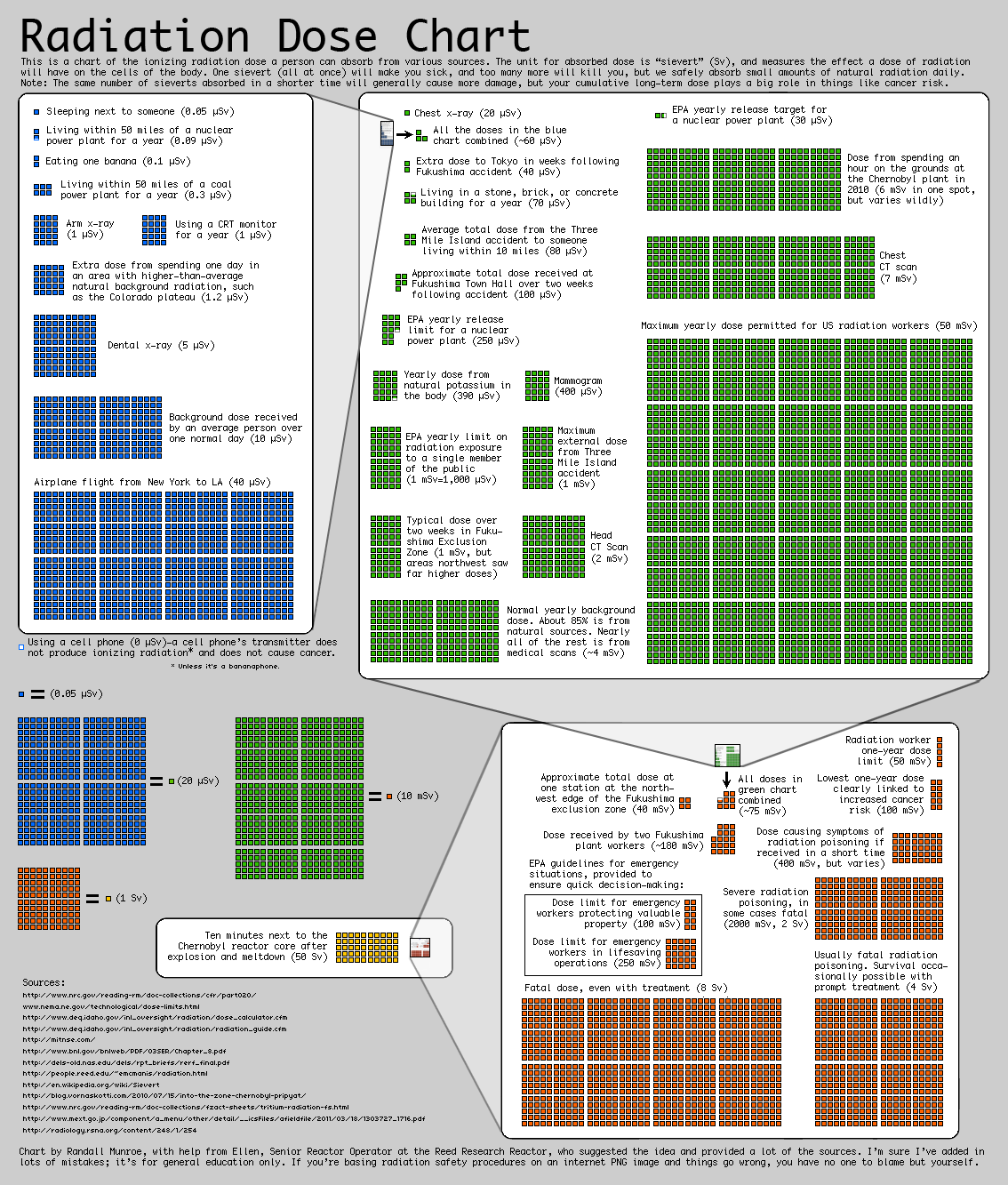
As many of you may know, the resulting leak from the nuclear plant did not only result in local increases of radiation but tests have shown that radiation has been detected in milk as far as California. So should we be worried? Should we, who find ourselves under the sun all the time, be seriously worried that we are drinking milk that "may give us cancer?" No, no we shouldn't. As presented to you by a well known webcomic, here is a radiation exposure chart  created and presented by XKCD:
Clicking on the image will allow you to view the actual size of it. The chart works in a clockwise manner, starting with the top left chart. 

*Ahem* As you can all see, we're constantly exposed to radiation no matter where we live. But what I'm truly saying is that we should be concerned by the AMOUNT of radiation we are exposed to RATHER than the idea that so and so is completely unsafe because there is an indication of radiation.

Monday, March 28, 2011

Bio(food)fuel: Is it good or bad?

Many of us have been introduced to alternative fuels as well as  alternative sources of energy with the hopes of reducing our dependency on fossil fuels. Alternative sources of energy range from solar energy, windmills, watermills, nuclear energy, etc; while alternative fuels range from biodiesel/ biofuel, electricity, vegetable oil, etc. What we're concerned of now is the production of biofuels such as ethanol and whether or not such fuel production is ultimately great for our society or if our choice in producing biofuel will result in some sort of economical downfall.

To begin with, ethanol provides further purpose in crop production, so in turn a portion of crops and cropland is diverted from only focusing on human consumption but also on fuel production. This results in higher price which pushes the need for higher income. This, of course, will result in many more people suffering from hunger.

In short, I have this question for all those reading this entry: does global warming kill thousands and thousands of people worldwide or is it hunger that lends a hand in killing those who are financially unfortunate? We aim to go green but is it worth the loss of those whose only concern is trying to find food and water on a daily basis? Now I don't mean to say that we shouldn't appreciate the benefits of biofuel but we should at least take into consideration the moderation we need in order to produce fuel without significantly and negatively affecting the economy.

Wednesday, March 23, 2011

Uniformed Grinding

I will be extending the information regarding the art of coffee in the technique of grinding. This technique, to put it bluntly, is not for those who are not willing to invest a good amount of money for a great cup of coffee. Why? The usual, homestyle method of grinding uses a multiple purpose grinder that utilizes blades. As the blades rotate, the coffee beans are cut apart. But this results in uneven grinding with large to fine particles. Furthermore, the longer the grinding process takes, the more heat that's generated which may result in burned beans. 

As an alternative, we have burr grinders. Instead of blades, beans are crushed by a wheel against a nonmoving surface. The spacing and position dictates how the beans are crushed which leads to a much more controlled grinding process with much less heat generated. Furthermore, there are two different types of burr grinders. One utilizes a wheel and is the less expensive of the two. The wheel burr grinder spins at a fast rate which sometimes result in a mess. Conical burr grinders tend to clog less, spin at a moderate speed, and produce less mess -- this is optimal for oily beans. 

Either way, you will be expected to pay from $100+ for a quality burr grinder.

Photo provided by Michellocafe.nazwa.pl

Monday, March 14, 2011

Vacuum Brewing

Photograph by Kadluba
I'll be taking a different route and instead of introducing you to the method(s) of coffee grinding, I will be introducing another method of coffee brewing. What you see here is a vacuum brewer and takes the infusion process to a different, and very much unique level. Through this method, you may experience the cleanest, purest cup of coffee and I'll show you how through the steps required to utilize it.

Primarily, we have to know how it works. Vacuum brewers utilizes a process of suction -- the result of expanding/ contracting gases and in this case, the gas is water vapor. With it comes four parts, two glass containers, a tube that connects the two, and a filter that allows water/ gases through but keeps sediments, in this case, coffee out. Those two containers sit on top of one another, connected b that tube, and there's a filter in between. Of course, all of it is set on top of a stove or other heat source.

Step 1 requires the actual assembly. Step 2 follows by filling the bottom container with water and the upper container with coffee grinds.  Through the process of heating water, water vapor is formed and water vapor requires relief somewhere and the only relief is through the tube. So as the water heats up and vaporizes at the bottom, liquid from the surface is pushed up through tube and into the second container. At this point, the coffee grinds are undergoing their infusion process. 

Within 1-3 minutes, the process of vaporizing, expanding, transporting of liquids, infusing is over. Remove the entire assembly off from its heat source. At this point, the cooling temperatures affect the vapors and actually contracts the gas, bringing the liquids from the top back to the bottom -- through the tube and ultimately leaving all coffee grinds at the top and pure, clean coffee at the bottom. 

There you go! Though people used to the French press might find it weak since there's more filtration going on, they're always allowed to adjust the amount of coffee grinds.


Monday, March 7, 2011

The French Press

Photograph By mhaithaca
Now here's a fine method of brewing if you insist on or are curious about the taste of bolder and much more flavorful coffee. In short, you'll find out that it's similar to the process in brewing tea. So what is it? A french press has a container, a metal filter attached to a rod that protrudes past the container's lid, and the lid itself. So now the entire brewing method starts with the grinding, the steeping, and the careful observation of time.


In this method, grinds must be slightly coarser than coffee grounds bought from the supermarket. This is due to the pores of the filter being significantly larger than that of regular paper filters*. But depending on the brand and make of the press, you may be able to use a french press with pregrinds as long as you don't mind the occasional bump with coffee grit.

Afterward. you'll have to measure out how much coffee you'll be required to use. In my opinion, a tablespoon per cup of water is suitable. Now boil x amount of water and as you're waiting, pour the measured amount of coffee into the container. When ready, pour the water into the container while stirring -- make sure to not overfill the container so that it can accommodate the added mass of the filter + rod. Now you'll place the lid, filter, rod (which is all essentially connected to one another on top). The rod will be protruding out of the lid at its maximum length indicating that the filter is still at the top of the container.

Now depending on how strong you wish to make your coffee, you'll have to wait a few minutes. A 2-4 cup press shouldn't take any longer than 2-3 minutes to steep. Afterward, you'll press down on the rod gently, pushing the grinds down. At this point, your coffee is ready and you're required to pour it all unto another container to avoid extra steeping time that may make your coffee bitter.

*There will be a detailed entry regarding the process of grinding at a later date.

- - Ken

Sunday, March 6, 2011

Coffee and its intricacy

Photograph by Jon Sullivan:


We are all aware of how coffee is usually brewed in your average household. There's either the instant mix method or the drip style method. Either way, people tend to only be familiar with these two when in reality, there is much more to it than what the majority know and can appreciate. In short, coffee is an art and it can not be explained in such short time, therefor I will be covering the topic of coffee throughout several posts.

Initially, its intricacy starts with what type of coffee beans are used. There are two main types: Arabica and Robusta. Arabica offers a much more flavorful experience, a fuller taste to it, and is seen as the complete opposite of Robusta; the much more economically preferred type within the mass producing coffee industry.

At first, it seems irrelevant. How should we be concerned with the differences? Considering the concept that we're used to either a 100% Robusta coffee and/ or a mix of Arabica and Robusta, we are missing out on what could be great coffee. Coffee that doesn't require creamers, loads of sugar, and whatever else must mask that bitter taste associated with Robusta beans. So I end this thought by asking you all...When was the last time you tried coffee black and enjoyed it?


- - Ken